How to Choose “Just-Right” Books for Emerging Readers
Pick a book that’s too hard, and your kindergartener stalls on every other word, gets frustrated, and decides reading isn’t fun. Pick one that’s too easy, and they breeze through without building any new skills. Somewhere in between is what teachers call a “just-right” book — one that stretches a young reader just enough to grow, without tipping into frustration.
Finding that sweet spot isn’t guesswork. A few simple checks can help you spot a just-right book on the library shelf or in your own stack at home.
What makes a book “just right”?
A just-right book has enough familiar words and patterns that your child can read most of it independently, with just a few tricky spots to work through. It should be interesting enough to hold their attention and challenging enough to teach them something new, whether that’s a fresh sight word, a phonics pattern, or a bit of vocabulary picked up from context.
Try the five-finger rule
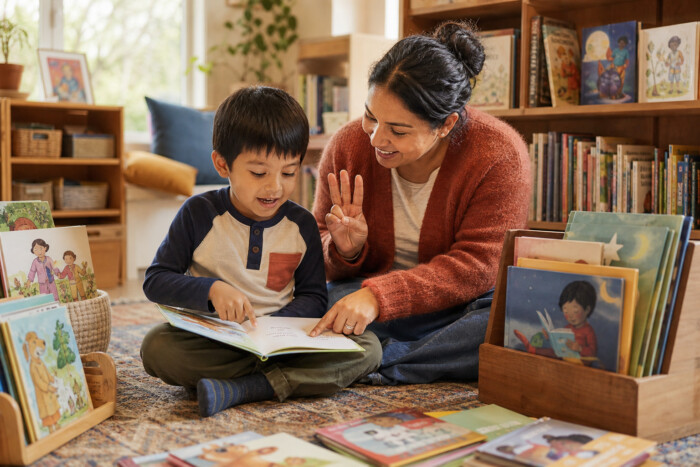
This simple test works well for kids who can already read a little on their own. Open the book to a page your child hasn’t read yet and have them read it aloud. Hold up a finger for every word they get stuck on.
- 0 to 1 fingers: The book is likely too easy for guided practice, though it’s still great for confidence-building or bedtime reading.
- 2 to 3 fingers: This is usually a just-right book — enough challenge to grow, not so much that it’s discouraging.
- 4 to 5 fingers: The book is probably better as a read-aloud for now, with you doing the reading while your child follows along and enjoys the story.
Decodable books vs. predictable books
Two book styles show up constantly at this age, and it helps to know the difference. Decodable books stick to phonics patterns a child has already learned, so they can sound out nearly every word independently — great for practicing a specific skill, like short vowel sounds or a word family. Predictable books use repeated sentence patterns and strong picture clues, like “I see a dog. I see a cat.” They’re less about decoding and more about building fluency, confidence, and a love of following a story. Both have a place on the shelf, and neither is “better” than the other.
Keep three levels in your book basket
Rather than searching for the one perfect book, aim for a mix:
- Read-to-me books: A level above what your child can read alone. You read these aloud, which builds vocabulary and a love of stories without any frustration.
- Read-with-me books: The just-right books, where you take turns or your child reads with light support on tricky words.
- Read-alone books: Easy, familiar favorites your child can read independently. These build fluency and confidence, and rereading them is never wasted time.
Signs a book is a good match
Beyond the finger test, watch your child’s body language. A just-right book usually comes with:
- Occasional pauses on tricky words, but not constant stopping
- A child who stays curious about what happens next
- Willingness to keep going, or even ask to read “one more page”
- Mistakes that are easy to work through together, rather than ones that shut the session down
If you’re seeing sighs, wiggling, or a flat refusal to continue, it’s a sign to set that book aside for later and reach for something easier in the meantime.
The takeaway
A just-right book isn’t about reading level labels on the spine — it’s about the fit between the book and the reader in front of you on a given day. Use the five-finger rule as a quick check, keep a mix of read-to, read-with, and read-alone books on hand, and pay attention to how your child feels during the story. Get the fit right, and you’ll spend a lot less time convincing your child to read, and a lot more time watching them want to.