
Sight Words vs. High-Frequency Words: What Parents and Teachers Should Know
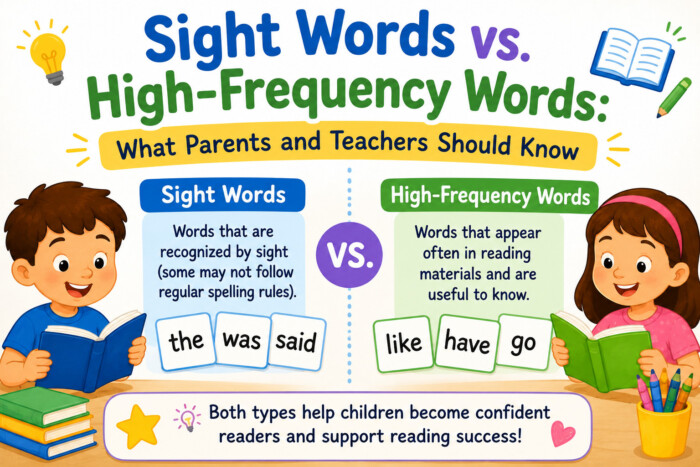
If you have spent any time around early reading, you have probably heard both terms used as if they mean the same thing. Sometimes they do overlap, but they are not identical, and knowing the difference can change how you help a child learn them. Here is a clear, jargon-free explanation.
What are high-frequency words?
High-frequency words are simply the words that appear most often in everyday text. Words like the, of, and, to, in, and is turn up so frequently that a handful of them can make up a large share of the words on any given page. They earn their place on a list purely by how common they are, not by how they are spelled.
Because a child encounters these words constantly, learning to read them quickly gives an outsized boost to overall reading fluency. The fewer times a child has to stop and work out a common word, the more energy they have for understanding the story.
What are sight words?
Sight words are words a child can recognize instantly, “on sight,” without sounding them out. Some of these words follow regular spelling patterns, and some do not. The ones that break the rules, like said, was, of, or come, are tricky because a child cannot reliably sound them out. Trying to do so often produces the wrong word. These are best learned by memorizing the whole word as a unit.
So “sight word” is really a description of how a word is read, instantly and from memory, rather than a description of how often it appears.
Where the two overlap, and where they part ways
Here is the key point: many words belong to both groups, which is why the terms get used interchangeably. The and said are both very common and best read on sight, so they qualify either way.
But the two ideas can also come apart:
- A word can be high-frequency yet easy to sound out, like up or can. It is common, but a child does not necessarily need to memorize it as a whole.
- A word can be worth learning on sight even if it is not among the most common, especially if its spelling is irregular and likely to trip a young reader up.
Thinking of them as two overlapping circles rather than one single list keeps things accurate.
Why the difference matters for teaching
The distinction is not just trivia. It points to two different teaching moves.
For words that follow regular patterns, lean on sounding them out. You want children practicing the skill of decoding, because that skill unlocks thousands of new words on its own.
For irregular words that resist sounding out, shift to whole-word recognition. Memory games, repeated exposure in real sentences, and multisensory practice work better here than asking a child to stretch out sounds that will only mislead them.
When you match the method to the word, you avoid two common frustrations: a child laboring to decode a word that cannot be decoded, and a child memorizing a word they could have read with a skill they already have.
A simple way to use this at home or in class
When a new word comes up, ask yourself one quick question: Can this word be sounded out? If yes, guide the child through the sounds. If no, treat it as a word to recognize on sight and practice it as a whole. That single question keeps your teaching aligned with how each word actually works.
The takeaway
High-frequency words are about how often a word appears. Sight words are about how a word is read. Plenty of words sit in both groups, but treating the two ideas as one can lead to teaching a word the hard way. Keep the question simple, can it be sounded out or not, and you will always know which approach to reach for.