How to Teach First Grade Vocabulary So It Actually Sticks
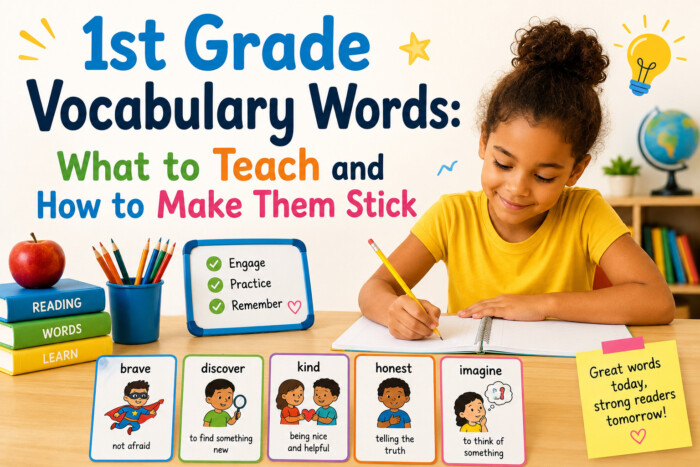
First grade is a turning point for young readers. In kindergarten, most words are short and tied to things a child can see and touch. By first grade, children keep building on those everyday words while slowly adding a few that name ideas and feelings, not just objects. Growing this vocabulary is one of the best things you can do to set a child up for confident reading and writing.
Here is a look at the kinds of words first graders are ready for, real examples to work from, and simple ways to help them stick.
What 1st grade vocabulary actually looks like
It is easy to imagine first grade vocabulary as a big leap into long, complicated words. In practice, it is mostly a wider set of common, useful words a child meets every day, with a small stretch toward the abstract.
Look at a typical first grade list and you will see familiar, concrete words like animal, friend, school, build, and carry. Alongside them sit a handful of words that ask a child to picture something they cannot touch, like idea, joy, love, and value. That gentle mix is exactly right for the age: plenty of solid, recognizable words, plus a few that gently stretch a child’s thinking.
You can see the full set on the 1st grade vocabulary words list, where each word links to its own page with a meaning, examples, and a sentence.
Grouping the words by the job they do
Rather than working through a list alphabetically, it helps to notice what each word does. Here are the main groups, with real examples pulled from a first grade list.
- Naming words point to people, places, animals, and objects: animal, baby, friend, father, mother, school, game, door, key. These are the easiest to teach because a child can usually see or picture them.
- Action words describe what people and things do: build, carry, draw, listen, throw, write, move, learn. First graders love these because so many can be acted out.
- Describing words add detail: happy, kind, quiet, little, good, better. These help a child move beyond plain words into richer language.
- Feeling and idea words name what happens inside or cannot be touched: joy, love, idea, value. These are the newest territory for young children and deserve a little extra attention.
- Connecting and common words appear constantly and hold sentences together: and, another, every, more, near, never, very, with. Learning to read these instantly is what makes reading feel smooth.
Grouping words this way lets you teach a few from each type instead of an overwhelming pile all at once.
How to make new words stick
A word a child hears once is quickly forgotten. A word a child uses, sees, and plays with becomes their own. A few reliable strategies:
- Use the word yourself, out loud, often. If you want your child to learn value, talk about how much you value their help. Children borrow the words they hear the people around them use.
- Connect each word to a picture or an action. Have your child act out carry or throw. Ask them to draw something that brings them joy. The stronger the image, the stronger the memory.
- Point words out in books. When one of these words shows up in a story, pause and enjoy it together. Ask what your child thinks it means before you explain.
- Ask your child to use it back. Learning locks in when a child produces the word themselves. A quick “Can you make a sentence with kind?” does more than any definition.
For the more abstract words like idea, joy, and value, lean extra hard on real examples from your child’s own life. A first grader understands joy best when it is tied to a moment they actually felt it.
Practice with quizzes
Once your child has met a set of new words, a short quiz is a low-pressure way to see what has stuck and keep the words fresh. The word quizzes at Little Word Lab give first graders quick, game-like practice with sight words and vocabulary, which pairs perfectly with the word list above.
The takeaway
First grade vocabulary is mostly a widening circle of common, everyday words, with a few that stretch toward ideas and feelings. Focus on the words that do the most work, naming words, action words, describing words, and the handful of feeling words, and give your child plenty of chances to hear, see, and use each one. Keep it playful and consistent, and their vocabulary will grow right alongside their confidence.