Word Families: The Secret Shortcut to Confident Reading
If your kindergartener or first grader can read “cat,” but freezes on “hat,” “bat,” and “mat,” they’re missing a trick that can unlock dozens of words at once: word families. Word families group words that share the same ending sound and spelling pattern, like -at, -an, or -ig. Once a child learns one family, they can often read every word in it with almost no extra teaching.
This isn’t a shortcut in the “skip the hard work” sense — it’s a shortcut in the best sense, the kind that lets a child feel like a strong reader faster, which keeps them motivated to keep going. Here’s what word families are, why they work so well for this age group, and how to start using them at home or in the classroom today.
What exactly is a word family?
A word family is a group of words that end in the same letter pattern and rhyme as a result. The pattern is usually a vowel plus one or more consonants, called a “rime,” and it stays the same while the first letter or letters (the “onset”) change.
- -at family: cat, hat, mat, sat, bat, fat
- -an family: can, fan, man, pan, ran, van
- -ig family: big, dig, fig, pig, wig
- -og family: dog, fog, hog, jog, log
- -ake family: cake, lake, make, rake, take
Because the ending stays constant, a child only has to swap out one sound at the front to read (or spell) a brand-new word. That’s a much smaller job for a beginning brain than sounding out every single letter from scratch every time.
Why word families work so well for kindergarten and 1st grade
Word families sit right at the intersection of phonics and sight-word reading, which is exactly where 5- and 6-year-old readers live. A few reasons they’re such a powerful tool:
- They build pattern recognition, which is how fluent readers eventually stop sounding out every word and start reading by sight.
- They make new words feel familiar instead of scary, since most of the word is already known.
- They naturally teach rhyming, which supports phonemic awareness — a skill strongly linked to later reading success.
- They give kids quick wins. Learning five or six new words in one sitting feels like real progress, and kids notice that.
- They support spelling as much as reading, since the same pattern that helps a child decode “sat” also helps them encode it.
How to introduce a word family for the first time
Start with one simple, short-vowel family, like -at or -an. Write the rime on an index card or whiteboard, then add different first letters one at a time, saying each new word out loud together. Ask your child what they notice about the words. Most kids will spot the pattern within the first few examples — let them say it in their own words rather than handing them the rule.
Once they can read the family with the letters in front of them, try it without the visual: say a word from the family out loud and ask them to write it, or say two words and ask if they rhyme. Moving between reading and spelling the same pattern locks it in much faster than reading practice alone.
Simple activities that make word families stick
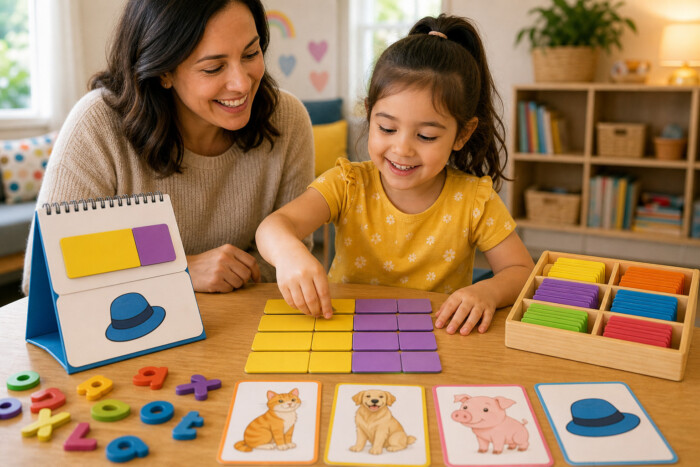
- Word family flip books: Write the rime on a strip of paper and attach a stack of small flaps with different first letters that flip up to reveal each new word.
- Rhyme sorting: Write a mix of words from two or three families on cards and have your child sort them into the correct family piles.
- Silly sentence building: Challenge your child to use three words from the same family in one silly sentence (“The fat cat sat on a hat”).
- Family scavenger hunt: Pick a family for the week and see how many matching words you can spot together in books, on signs, or around the house.
- Build-a-word blocks: Use letter tiles or magnets so your child can physically swap the first letter while the rime stays put.
Which families to teach first
Short-vowel families are the easiest starting point because the sound-spelling relationship is the most consistent. A helpful order to work through is -at, -an, -ap, -ig, -in, -og, -ug, and -et, before moving on to long-vowel families like -ake, -ame, -ide, and -oke. There’s no need to rush — mastering a handful of families deeply is far more useful than skimming through a long list.
The takeaway
Word families give young readers a pattern they can lean on, turning what feels like an endless list of new words into a small set of familiar shapes with different first letters. A few minutes a day with flip books, rhyme sorting, or silly sentences is enough to build real momentum. Start with one simple family this week, celebrate every new word your child unlocks, and watch how quickly “I can’t read that” turns into “I know that one!”