
Why Your Child Mixes Up Tricky Sight Words Like “Was” and “Saw” (and What Actually Helps)
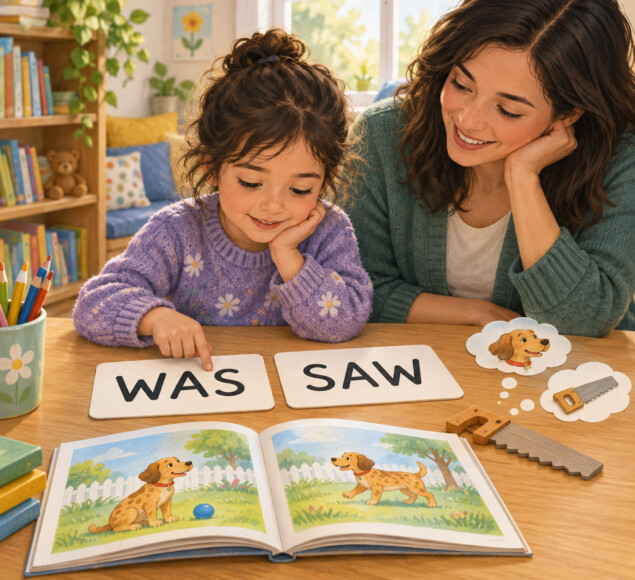
Your child reads “I saw the dog” one page and “I was happy” the next — and then flips them the very next time those words show up. If this sounds familiar, you’re not watching a reading problem develop. You’re watching a completely normal, very common mix-up play out, and there are a few specific reasons it happens so often with certain sight words.
Here’s why words like “was” and “saw” (and a handful of other repeat offenders) are so easy to confuse at this age, and what actually helps it click — beyond just saying the word again and hoping it sticks.
Why these specific words trip kids up
A few things stack up to make certain sight words especially confusing for kindergarten and 1st grade readers:
- Same letters, different order. “Was” and “saw” use the exact same three letters, just rearranged — a visual trap for eyes that are still learning to track letter order carefully.
- No picture to anchor to. Words like “dog” or “cake” can be pictured in a child’s mind. Function words like “was,” “for,” and “of” are abstract, so there’s nothing concrete to hang the meaning on.
- High frequency, high visibility. Because these words appear constantly, the mix-ups happen constantly too — it just feels like a bigger problem than it is.
- Letter reversal tendencies. Many kids this age still reverse or flip letters and short sequences while their visual processing catches up, which is exactly what’s happening with “was” and “saw.”
Other sight words that commonly get swapped
- was / saw
- there / three
- from / form
- for / of
- said / sad
- them / then
- on / no
Notice the pattern: nearly all of them share the same letters, a similar shape, or a similar sound. That’s not a coincidence, and it’s not a sign your child isn’t paying attention.
Strategies that actually help
- Read in context, not isolation. “Was” and “saw” are much easier to tell apart inside a full sentence than on a lone flashcard, since the sentence meaning gives extra clues.
- Give each word a tiny story. A silly, specific image helps an abstract word stick — “saw has two eyes (the two S’s… just kidding) — picture a saw cutting wood when you SEE it.” Any memorable, personal hook works better than repetition alone.
- Trace it big. Write the word in large letters and have your child trace it with a finger while saying each letter out loud — the physical motion reinforces letter order.
- Slow down at the mix-up point, not before. Let your child read at a normal pace and only pause when the swap actually happens, rather than warning them every time the word is coming up.
- Practice both words side by side. Write the pair together and talk through what’s different about them, rather than teaching them on separate days where the contrast never gets made explicit.
- Be patient with repetition. These particular mix-ups often take longer to resolve than other sight word errors simply because the words are so visually similar — that’s expected, not a red flag.
What’s normal and not worth worrying about
Occasional reversals and word swaps are a typical part of learning to read in kindergarten and 1st grade, and most resolve with age, exposure, and practice — not with extra drilling. It’s only worth a conversation with your child’s teacher if the mix-ups are frequent across many different words, persist well into 1st or 2nd grade without any improvement, or come bundled with other reading or writing struggles.
The takeaway
“Was” and “saw” mix-ups aren’t a sign your child is behind — they’re a predictable bump caused by two words that genuinely look alike to an eye still learning to track letter order. Practice the pair side by side, read them in full sentences instead of isolation, and give the trickiest ones a small, memorable hook. With a little time and the right kind of practice, these specific swaps tend to sort themselves out.