
Phonics vs. Sight Words: What’s the Difference and Why Kids Need Both
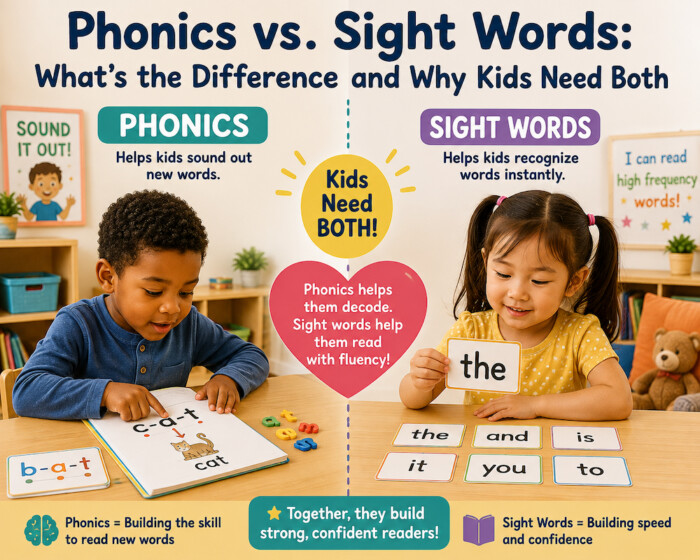
If you’ve sat in on a kindergarten or 1st grade reading lesson lately, you’ve probably heard both terms thrown around: phonics and sight words. Some programs seem to lean hard on one and barely mention the other, which can leave parents wondering which approach is “right.” The truth is simpler and more reassuring than the debate makes it sound: young readers need both, because each one does a job the other can’t.
Here’s a clear, no-jargon breakdown of what phonics and sight words actually are, how they work together, and how to support both at home without overcomplicating reading time.
What is phonics, exactly?
Phonics is the relationship between letters and the sounds they make. When a child sounds out c-a-t and blends it into “cat,” they’re using phonics. It’s a decoding skill: give a child the code (which letters make which sounds), and they can unlock thousands of words on their own, including words they’ve never seen in print before.
Phonics is powerful because it’s generative. A child who has learned that “sh” makes one sound can read ship, shop, fish, and wish without being taught each word individually. That’s the whole point: teach the pattern once, and it pays off over and over.
What are sight words, then?
Sight words are words a child recognizes instantly, by memory, without sounding them out. Some sight words are perfectly regular and could technically be decoded, but they’re taught for instant recognition anyway because they show up so often that fluency depends on reading them without hesitation. Others, like said, was, of, and the, don’t follow standard phonics rules at all. Sounding out said the way it’s spelled would get a child nowhere close to the right word.
Because these irregular words resist decoding, they’re best learned as whole units, through repetition, memory games, and seeing them again and again in real sentences.
Why kids need both, not one or the other
Here’s where the “phonics vs. sight words” framing goes wrong: it’s not really a competition. Think of them as two different tools for two different jobs.
- Phonics gives a child a strategy for reading new, unfamiliar words independently. Without it, every new word has to be taught from scratch, which doesn’t scale.
- Sight words give a child speed and fluency on the words that show up constantly, especially the irregular ones that phonics can’t crack on its own.
- A reader who only sounds things out will stall on common irregular words and read painfully slowly. A reader who only memorizes words will hit a wall the moment they meet a word they haven’t memorized yet.
Strong early readers use both skills together, often without even realizing it: decoding the words that follow the rules and instantly recognizing the handful that don’t.
How to tell which approach fits a word
A simple mental test helps here. When your child hits a new word, ask: can this be sounded out using the phonics rules they already know? If yes, coach them through blending the sounds rather than just telling them the word. If no, because the spelling is irregular, treat it as a word to memorize on sight, and practice it in short, repeated bursts.
This keeps you from two common traps: making a child sound out a word that can’t be sounded out (which is frustrating and doesn’t work), and having them memorize a word they could easily decode with a skill they already have (which wastes practice time).
Simple ways to practice both at home
- For phonics: play with word families (like -at, -an, -ig) so your child sees how changing one letter changes the whole word. Sound out unfamiliar words together in books instead of just supplying them.
- For sight words: keep a small, rotating stack of flashcards for words your child’s class is currently learning. Point them out in everyday reading, cereal boxes, street signs, picture books, so the words show up outside of drill time too.
- For both: read aloud together daily. Every book naturally mixes decodable words and sight words, so shared reading gives both skills real practice without feeling like a lesson.
The takeaway
Phonics and sight words aren’t rival methods fighting for your child’s attention, they’re teammates. Phonics unlocks new words by teaching the code behind them. Sight words provide instant recognition for the common words, especially the irregular ones, that keep reading moving smoothly. A child who’s building both skills at once isn’t getting a mixed message. They’re getting the full toolkit they need to become a confident, fluent reader.