
Letter Reversals: What’s Normal for Kindergarten and 1st Grade Writers (and What’s Not)
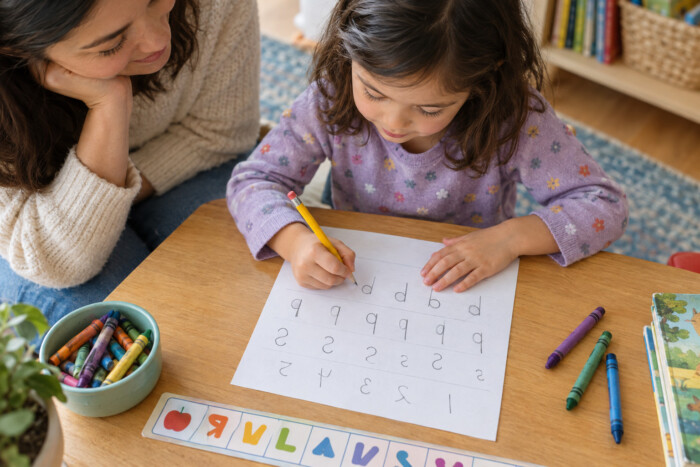
Opening a worksheet to find “b” written like “d,” an “s” curling the wrong way, or a 7 that looks like its own mirror image can set off real alarm bells for a parent. Before you worry, take a breath: letter and number reversals are one of the most common things young writers do, and for most kindergarteners and 1st graders, they’re simply part of learning to write — not a sign that something is wrong.
Why reversals happen in the first place
Young children are still building two skills at once: recognizing that letters have a fixed orientation, and controlling a pencil well enough to reproduce that orientation on paper. Up until around age 7, many kids simply haven’t locked in the idea that a letter facing left means something completely different from the same shape facing right — unlike most objects in their world, where a cup is a cup no matter which way it’s turned. Add in a still-developing sense of left and right, and reversals become less a mistake and more an expected stop along the way.
The letters and numbers most likely to flip
- b and d. The single most common reversal pair, since both are a line with a loop, just facing opposite directions.
- p and q. Same shape problem as b and d, just lower on the line.
- s and z. Both involve a diagonal stroke that’s easy to start from either end.
- 2, 5, and 7. Any number with a curve or diagonal is fair game, especially 7, which has no loop to anchor its direction.
When reversals are nothing to worry about
- Your child is 4 to 7 years old. Occasional reversals are developmentally typical through 1st grade and often into the start of 2nd.
- They happen inconsistently. A child who writes “b” correctly sometimes and backward other times is still sorting out the pattern — that’s normal variability, not a fixed error.
- Reading isn’t affected. Many kids who reverse letters on paper can still read those same letters correctly in a book. That gap is a good sign; it shows the confusion is about writing, not recognition.
- They self-correct when asked. If a quick “does that letter look right to you?” prompts your child to fix it themselves, their internal sense of the letter is intact — the hand just needs more practice catching up to it.
Simple ways to help without making it a big deal
- Anchor tricky pairs with a memory trick. “Bed” is a classic for b/d: make two fists with thumbs up, and the left hand looks like a lowercase b, the right like a d — just like the shape of a bed frame.
- Practice letters in the air or on a big surface first. Writing large with a finger, a paintbrush, or a stick in sand builds the motor memory for direction before a child has to manage a tiny pencil.
- Point, don’t correct every single time. A gentle “check that one” teaches your child to self-monitor. Fixing every reversal for them skips that step.
- Keep a reference letter nearby. A small alphabet strip taped to the table lets your child check a tricky letter themselves instead of asking or guessing.
- Celebrate progress, not perfection. Reversals fade gradually, with good days and backslide days along the way. Notice the overall trend, not any single page.
When it might be worth a closer look
Reversals on their own are rarely cause for concern at this age. It’s worth mentioning to your child’s teacher or pediatrician if reversals are still frequent and consistent well past age 7 or 8, if your child also struggles significantly with reading progress, or if you notice other persistent difficulties like trouble with rhyming, remembering sequences, or telling left from right in everyday situations. One quirky worksheet is not a pattern — a cluster of ongoing struggles is what’s worth flagging.
The takeaway
A backward b or a mirrored 7 is one of the most ordinary things a kindergartener or 1st grader can put on paper. Give the memory tricks a try, keep correction light and low-pressure, and trust that most reversals quietly sort themselves out with time and practice. Save your worry for a real pattern over many months — not for today’s homework page.